Project Matador: perhaps the most important new energy concept in America

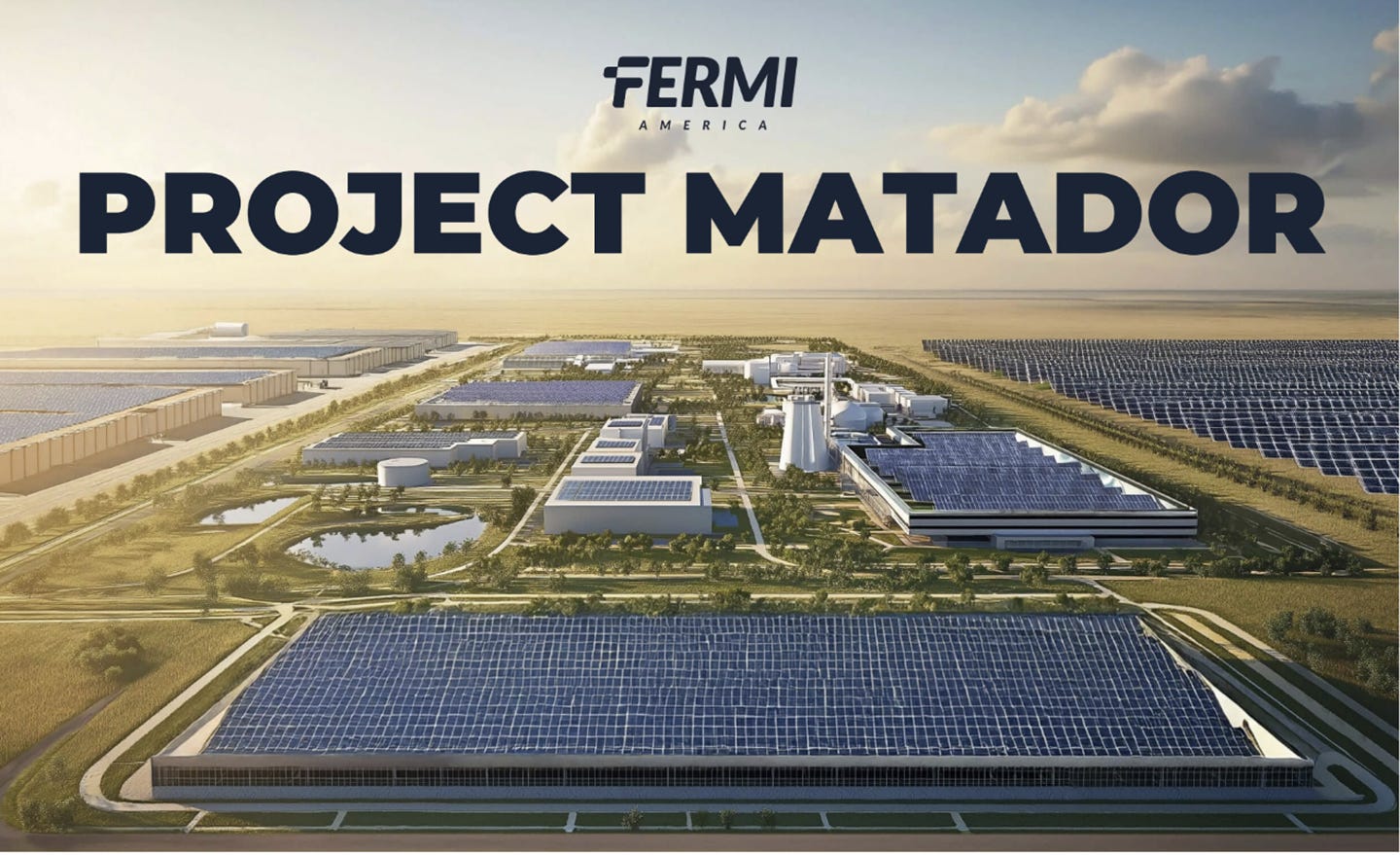
A new energy company, Fermi America, cofounded by former Texas governor and once head of the Department of Energy, Rick Perry, is planning an 11 GW new energy complex near Amarillo, Texas, called Project Matador. Matador will test multiple new paradigms in electric generation and delivery, including large and small-scale air-cooled nuclear energy, integrated with gas, solar, and Battery Energy Storage Systems (BESS).
Electricity generation will be co-located with large data centers and chip manufacturers on a contiguous 5,263-acre site in a behind-the-meter (BTM) arrangement, cutting out the utilities. The financing of this project will come largely from selling shares to the public, a first in history for financing the construction of nuclear power plants. Fermi America will be structured as a publicly traded Real Estate Investment Trust (REIT), which results in a high-yield investment that avoids paying corporate taxes.
The success or failure of this project will have far-reaching consequences on the direction of electricity policy in the US and other parts of the world. If the project succeeds, it could pave the way for the rapid buildout of nuclear energy and prove a new model for delivering electricity in an era where grid congestion is choking off the supply of electricity needed for a growing economy. To pull this off, the management team will have to walk on water, ensuring that large customers sign up, enough money is raised, and the nuclear plants are built to an aggressive schedule of 5 years of construction for each unit. A feat skeptics will say is impossible.
Overview
The world is in the midst of an AI revolution. The US is in a race with China to stay ahead, while Europe is falling behind; the stakes couldn’t be higher. The pace of advancements is breathtaking, but there isn’t enough electrical capacity to power the expected boom. AI manufacturers, such as those in data centers and chipmakers, have stringent energy requirements. They need vast amounts of ultra-reliable power, on demand without restrictions, and they want it to be emission-free.
The purpose of Matador is to satisfy these requirements by providing its customers with power targeting 99.999% uptime and above, low-latency delivery (free from brownouts), energy freedom (free from demand response programs), and low CO2 emissions. Unless otherwise stated, the primary sources for this article come from the IPO filing submitted to the SEC on Sept 24, 2025, and the Combined Operating License (COL) application filed with the NRC.
The generation mix of Matador will consist of 4 air-cooled AP1000 nuclear reactors (~4 GW), 2 GW of Small Modular Reactors (SMRs), 4.6 GW of natural gas generation, and up to 1.75 GW of solar power, totaling around 11 GW of firm power, plus the variable solar. Additionally, Matador will be connected to the local electricity grid to receive a small percentage of its power, eventually about 2%. Finally, the site will be connected to a nearby, mature fiber-optic network. This is sufficient to meet the peak demand of 11 GW of data centers. To put the size in perspective, the US currently has about 54 GW of data centers.
Figure 1 shows the layout of Matador. The magenta regions represent nuclear plants, the orange areas are gas plants, and the yellow regions are data centers. Next to Matador is the Department of Energy’s Pantex plant, which is America’s primary nuclear weapons factory. The proximity of the Pantex plant adds value to the Matador site due to its known characterization for nuclear-related activities, which can expedite many of the nuclear-related regulatory issues.
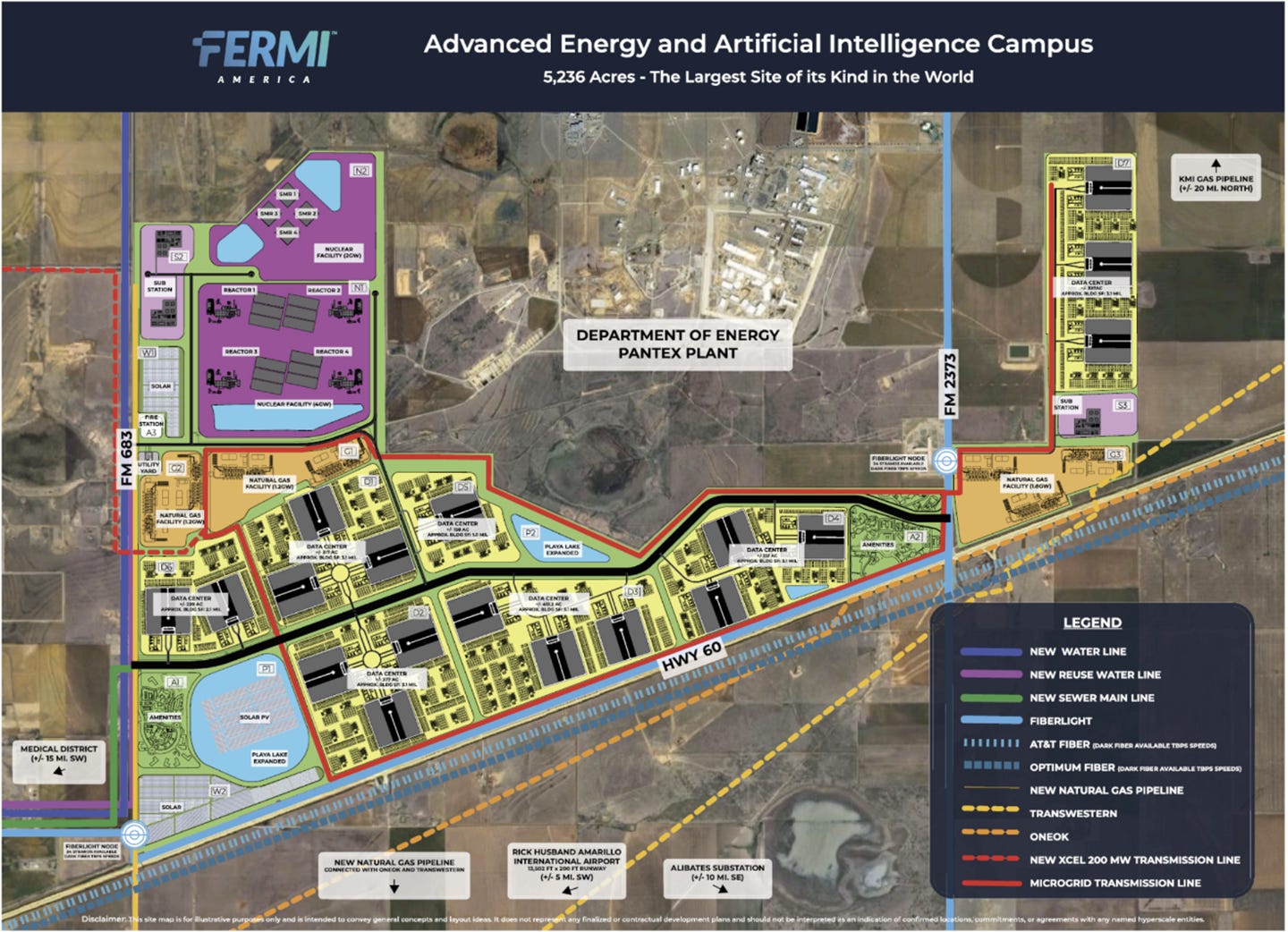
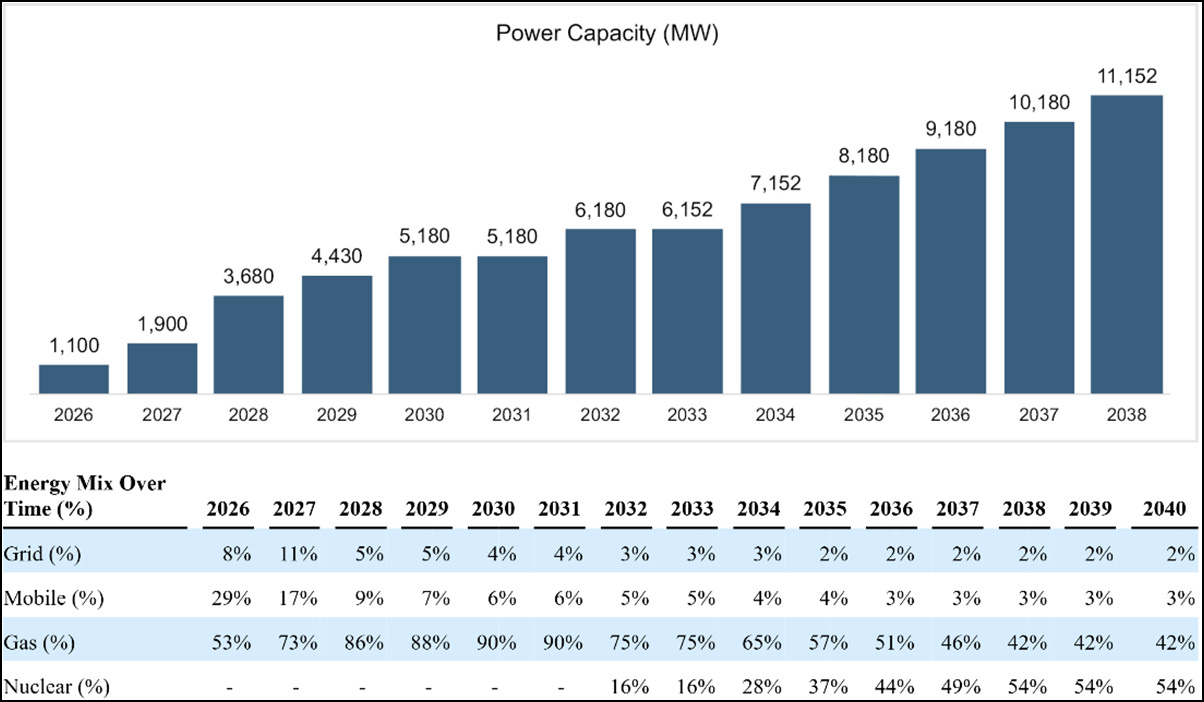
Figure 2 shows the timeline of development. 2026 is the first year of operation, when it is expected that 1 GW of power will be available for data centers, powered by a combination of combined cycle gas and mobile generators, plus 8% from the local grid. As time progresses, the 4 AP1000 nuclear plants will phase in to full operation by 2038. The expected mix in 2038 is 2% grid, 3% mobile, 42% gas, and 54% nuclear. The role of solar power is to reduce gas consumption during peak demand periods, which occur on hot and sunny days.
In addition to generation, Battery Energy Storage Systems (BESS) will be used to modulate the electricity coming from generators, ensuring a high degree of voltage and frequency stability. The BESS units can respond instantaneously to any voltage or frequency fluctuations coming from the generators. This produces a highly conditioned power, free of brownouts. The expected size of the BESS capacity is 1/3 of the Information Technology (IT) capacity.
Behind the meter
The electricity grid in the US has become so congested that it is increasingly difficult to connect a new power source. Delays can exceed 5 years, resulting in power shortages during periods of peak demand. The primary solution currently is demand response, which incentivizes or requires consumers to curtail their electricity usage temporarily as needed.
The situation in Texas has gotten so bad that in 2025, Texas passed a law granting ERCOT the authority to curtail, disconnect, or require demand response from large power users—including data centers and other non-critical large loads—in the event of a grid emergency. Data centers have emergency backup generators, but they are reluctant to use them, as doing so would violate local noise and emissions regulations. Data centers want to be good neighbors. Additionally, using the backup generators poses numerous operational risks.
Matador solves this by providing its customers with a behind-the-meter (BTM) arrangement that is a local microgrid, independent from the primary grid. BTM means not visible to the utilities. BTM is primarily used for rooftop solar and battery installations in homes and commercial properties. Doing this at an industrial scale is rare. Industrial consumers are happy to pay a premium price to utilities to avoid the complexities of building their own highly reliable generators.
The BTM arrangement has three primary advantages: it avoids the expenses and losses of transmission and distribution, it protects customers from being subjected to demand response programs, and it provides faster access to power.
Critics of using BTM power for industry claim that the costs will be too high due to the need for the excess redundant generation required for high reliability. This doesn’t make sense when we observe that the load factor (utilization rate) of a grid is typically 53%, vs a data center, which runs at about 86%. Based on this, we should expect the BTM power for data centers to need less generation redundancy.
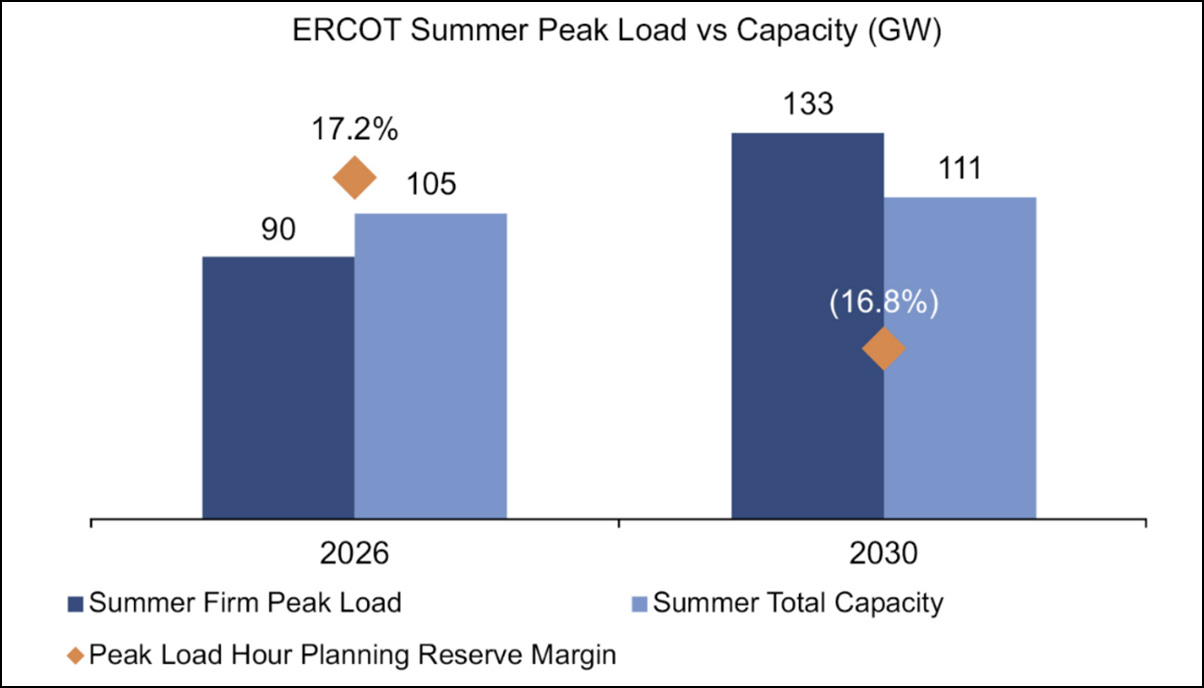
The grid congestion problem is only expected to worsen over time. Figure 3 compares the firm load to the peak load in ERCOT for 2026 vs 2030. In 2026, a reserve margin of 17.2% is expected, but it is projected to fall into a deficit of 16.8% by 2030.
Matador will get revenue by selling power to its on-site customers and offering them three options to satisfy their IT requirements:
Lease land and build their own data center on site from the ground up.
Lease an empty building and fill it with their own equipment.
Lease a complete turnkey data center solution.
Gas generation
Project Matador is located adjacent to the Panhandle-Hugoton Gas Field, one of the largest known natural gas fields in the US. Matador plans to connect to nearby gas pipeline infrastructure, which could enable it to scale up to 11 GW of natural gas-fired dispatchable power if needed.
Access to large quantities of gas is the key to bootstrapping its business and managing long-term risks. The gas enables Matador to immediately begin building the data center side of the company while working on the longer-term zero-carbon nuclear side. The flexibility of the gas means that if the nuclear plants are behind schedule, gas can fill in to keep the data center side growing.
Nuclear power
Matador has chosen the Westinghouse AP1000 for its large-scale reactor design. The last two reactors built in the US were AP1000s, Vogtle 3 and 4. These took more than ten years to construct and cost more than double the expected amount. Despite this, the AP1000 is a logical choice as it is emerging as a global standard. The cost overruns at Vogtle were due to several factors, including: it was a first-of-a-kind version of a new design, construction started before the design was completed, additional regulations like the aircraft impact rule were added during construction, the US had lost its expertise in building reactors, and there were no supply chains.
The first unit is scheduled to begin construction in 2027, with additional units to follow in 1- to 2-year increments. The staggering of the builds optimizes the use of equipment and labor. Additionally, lessons learned from earlier builds are applied to the later builds. They are planning for a 5-year construction period per reactor, costing $7,500/kW for the first unit, with a 15% decline for each additional unit. This is an aggressive schedule and an optimistic price indeed. The company believes this is doable due to an improved regulatory environment, incorporating the lessons learned at Vogtle, and assembling an A-team of developers.
Hyundai was selected as the lead developer for construction. Hyundai has built 22 reactors, most of them completed on time and within budget. For instance, they recently built 4 APR1400 units at the Barakah nuclear power plant in the United Arab Emirates, which were delivered ahead of schedule and within budget.
Mesut Uzman was selected to serve as the Chief Nuclear Construction Officer. He brings extensive experience managing large-scale nuclear projects, including the aforementioned Barakah plant. In addition, he played key roles in the construction and commissioning of 12 units in China (including four Westinghouse reactors), and multiple upgrade and completion projects in the United States.
Amarillo, Texas, is not an ideal location for building nuclear power plants due to its limited water resources for cooling. So, air cooling will be used instead. Air cooling was once considered impractical, but recent thinking on this has changed. This will be a first in history for large-scale commercial reactors like the AP1000, demonstrating that large-scale nuclear power can be built practically anywhere.
While air cooling is new for nuclear, it has been used numerous times for large-scale combined cycle gas plants. One drawback is that air cooling will reduce the power output by about 5 to 7% due to water being a more efficient coolant.
They are also planning to build 2 GW of Small Modular Reactors (SMRs). The COL makes no mention of any SMRs, so the thinking on them is still in the preliminary stage. SMRs are expected to be more expensive, but they offer flexibility by allowing for fine-tuning of the total nuclear capacity. Fermi is positioning itself as a leader in nuclear power construction and operation, so it undoubtedly wants to gain experience with SMRs. To develop them, Fermi has signed a Memorandum of Understanding (MOU) with Doosan Enerbility. Doosan is a Korean company with extensive experience in nuclear energy, including SMRs.
Fermi America makes clear their rationale for relying on nuclear as the primary energy source: “Conclusion: The proposed nuclear project is the only path that meets the technical, economic, and environmental thresholds required. All other configurations—gas alone, grid alone, renewables alone, or alternative combinations—result in inferior reliability, higher emissions, and failure to deliver the mission-aligned energy independence required by Fermi America and its tenants.”
Solar
Matador plans to deploy up to 1.75 GW of solar power. Solar has three distinct disadvantages: it is highly intermittent, has low energy density, and its output falls by 50% during winter. But solar does bring something to the table in Texas. On hot sunny days, when air conditioners are blazing, electricity prices are at their highest. Texas is an energy-only market, which means electricity prices can soar to incredible highs during peak consumption. Solar arrays are simultaneously at their peak output. This produces a complementary effect when paired with nuclear or combined cycle plants, provided that the solar is used in an optimal quantity.
The company considers the optimal ratio of solar to gas capacity to be 1:3.5. The goal is to use enough solar to offset gas usage when prices are high. Used in this way, the high cost of overbuilding and storage is avoided—solar power doesn’t need to be reliable; that’s the job of gas and nuclear. It simply needs to reduce costs and make the project greener.
The primary challenge to using solar energy is finding enough space. A 1.75 GW solar array will require about double the size of the entire Matador campus. As such, most of the solar panels will have to be located off-site on nearby vacant land.
The financing
Financing the project will come from three primary sources: private investors, government loans, and an Initial Public Offering (IPO) of stock.
Fermi America has raised $350 million in private capital so far, including $100 million as part of a Series C equity funding round led by Macquarie Group, plus a $250 million loan, funded solely by Macquarie’s commodities and global markets business.
The DOE’s Loan Programs Office (LPO) will provide a low-interest loan for at least 1 or 2 of the reactors. Fermi is currently applying for loans, but it is unclear how much they can count on. The level of funding available in the LPO program is in flux due to recent budget cuts. An LPO loan can fund a reactor at an interest rate of approximately 5.5% (including 20% from equity), which will significantly lower the lifetime cost of the energy produced.
At least 2 of the reactors will also be eligible to claim the Investment Tax Credit (ITC), which reduces the capital cost by 40%. The ITC starts at 30%, with an additional 10% add-on. Matador’s 10% adder applies to energy projects sited in designated “energy communities”. Generally, areas that have experienced significant job losses or tax revenue declines due to coal, oil, or natural gas industry contractions, or have historically relied on fossil fuel jobs. The ITC is time-limited by recent changes in the Inflation Reduction Act (IRA), which means that only two of the reactors will likely start construction in time to meet the deadline.
Based on all of the assumptions so far ($7,500 kW CAPEX, LPO loan, 40% ITC), the levelized cost of the first 1 or 2 reactors will be around $50/MWh. This is an extraordinarily low price. Of course, in the real world, things rarely go according to plan. Considering that Microsoft is believed to have signed a contract to pay more than $100/MWh for the power generated by the Three Mile Island reactor (when it’s restarted), there is considerable room to accommodate missed goals.
If the first two reactors are built even close to the 5-year schedule, prices will still be pretty low. This allows for industrial learning to keep costs down for the remaining, unsubsidized reactors. The unsubsidized cost of an AP1000 is expected to fall to $4,625/kW after 10 to 20 units are built. This has already happened in Pakistan and China. $4,625/kW equates to a levelized cost of $66/MWh.
Fermi is planning an IPO to raise funds from the public, with a trading start date of October 1, 2025. They have applied to list the stock on the Nasdaq and the London Stock Exchange under the symbol FRMI. The company is offering 25 million shares of common stock. The price range is $18 to $22 per share, with a target of raising up to $550 million, resulting in a fully diluted market capitalization of approximately $12 billion.
The stock is structured as a REIT, which must distribute at least 90% of its taxable income in the form of dividends. This approach avoids paying corporate taxes, resulting in a tax-efficient, high-yield investment. If the IPO succeeds, it could be a game-changer that paves the way for a new, privatized method of funding the construction of nuclear power plants.
Even supporters of nuclear energy are convinced that the success of nuclear energy depends on strong government support. Matador is clearly depending on government support for its initial reactor development, but it is also testing the concept of complete privatization. No commercial reactor has ever been built outside of the framework of a regulated utility, or at least partial government ownership. A truly privatized nuclear industry has great potential for rapid expansion.
Conclusion
Yet not everyone is convinced that Fermi’s bold vision is the right path. According to many prominent experts in academia, the approach of Fermi America is flawed. They believe BTM is not suitable for industrial consumers, and reliability is best achieved through large-scale enhancements to the grid, extensive battery storage, Virtual Power Plants (VPPs), and complex demand response programs. Solar and wind should be the primary sources of electricity, as they believe nuclear energy is too expensive and takes too long to build.
Fermi America is clearly taking a different approach. They have decided not to wait for grid enhancements that are not in the planning and may never come. They argue that making solar and wind power reliable is too expensive and uses too much land. They are betting that using nuclear energy will be faster, cheaper, greener, and give them a huge competitive advantage.
Fermi’s current proposal is not 100% emission-free. However, it’s easy to see that as America’s nuclear industry is reestablished, the natural gas generation can be easily phased out. The same cannot be said of a solar-powered grid. As the percentage of solar power usage increases, the difficulty and expense of making it reliable also rise. There is still no example of a solar-powered micro-grid that is year-round 100% reliable without using fossil fuel.
Fermi America plans to expand its concept nationwide and even internationally. The idea is not limited to AI-related industries. This concept can also be applied to large industrial parks with companies that require emission-free process heat. In addition to the electricity, the reactors generate immense amounts of “waste” heat; instead of throwing it away, co-location of industry allows it to be utilized for various industrial processes.
If Fermi succeeds, many others will follow suit. Even demonstrating that an AP1000 can start construction on time will have a significant positive impact on the nuclear industry. There is a huge pent-up demand for nuclear power, but developers have been deterred by the massive cost overruns incurred from building the Vogtle 3 and 4 plants, which resulted in the bankruptcy of Westinghouse.
Calling Matador bold is an understatement; it’s audacious. Matador breaks all the rules and proposes generating enough electricity on a small plot of land to power a typical midwestern state or a European country. Fermi America has a lot going for it; they have a plan that looks great on paper and has strong support from the White House. It won’t hurt that they named the reactors Trump 1 to 4. But audacious plans also present existential risks. Investors should plan to make either a lot of money or lose it all. The key milestone coming up is when Fermi signs its first large-scale contract with an AI firm; failing to do that soon, the company could easily collapse.
This one is going to be a nail-biter.
If they can build a single AP-1000 on schedule and on budget they will have done something important and remarkable.
"Audacious"--as you say--but interesting concept given the specifics. I learn so much from your insights, logic, and thoughtful explanations
I can only say, with apologies to Shakespeare ("What's in a name?"), that a reactor by any other name would sound...sweeter. But that's just me.